Making Sense of Wetting Agent Labels, Claims, and Standards
Wetting agent labels can vary per state in regards to ingredients and claims. This is partly due to the current lack of standards in the turf industry.

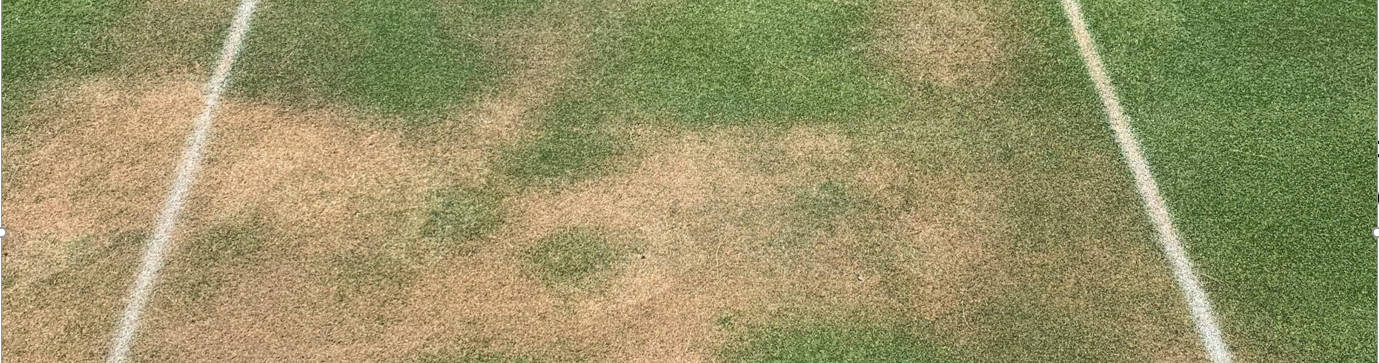
Soil water repellency, or hydrophobicity, creates tremendous challenges for irrigation. Hydrophobicity is common in sandy soils where plants produce lots of organic matter and root exudates. These organic materials create coatings on soil particles, and form hydrophobic barriers that prevent water from infiltrating into the soil. Hydrophobicity often occurs in a patchy pattern, referred to as Localized Dry Spot (LDS). These LDS are visible as yellow-brown colored patches.
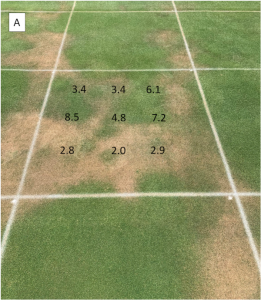
Golf course turf is typically irrigated to prevent the grass from wilting. That means that the driest areas dictate when irrigation is needed. When localized dry spot occurs, it forces an irrigation event over the whole area to prevent the LDS from drying out even more, even if the dry spots are only a small percentage of the total area. However, when irrigated, the dry spots resist wetting, and the irrigation water often flows laterally to adjacent areas that become wetter. As a result, a tremendous variability in soil moisture occurs once LDS is present (see image 1), and the differences are difficult to reverse.
Figure 1: Untreated turf
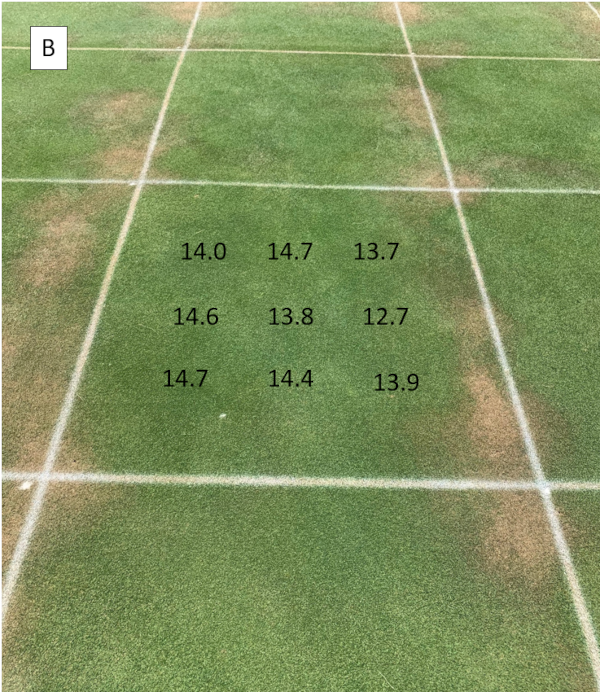
Wetting agents directly interact with the hydrophobic coatings that cause LDS, and result in much better uniformity of soil moisture across the treated area (seee image below). By reducing the hydrophobicity, irrigation or rain water will be able to infiltrate the soil more evenly.
Figure 2: Turf treated with an Exacto wetting agent
There is a debate that rages often – do wetting agents actually increase soil water content? The soil water content in Figure 3 is misleading. It would be tempting to conclude that the wetting agent treatment (B) increased soil water content, but that is not true. Rainfall increased soil water content – the rain infiltrated into the soil, and the soil got wetter. In the untreated plot, hydrophobicity prevented that rainwater from infiltrating into the soil. The wetting agent treatment prevented soil hydrophobicity, so the rain was able to penetrate.
Figure 3. Plots at the OJ Noer Turfgrass Research and Education Facility (Madison, WI) on July 19, 2021. Numbers represent % soil volumetric water content. Untreated plots (A) exhibit severe localized dry spot and a high degree of variability across the 5’ x 5’ plot area. The plot treated with Exacto wetting agent (B) has better moisture uniformity and more volumetric water content resulting from better rainwater infiltration.
Conventional wetting agents reverse soil hydrophobicity but don’t affect the soil’s water-holding capacity. However, high molecular weight polymers can hold water in the soil, similar to the effect of peat, biochar, or other soil amendments on water-holding capacity. Most conventional wetting agents do not contain these polymers and only address soil hydrophobicity. Exacto has been researching new wetting agent products with high molecular weight polymers that increase soil moisture uniformity and soil water holding capacity.
Although wetting agents can’t create water, they can be a valuable tool to maximize the availability of irrigation and rainwater.
Want to learn more about Exacto’s wetting agent research? We would love to hear from you!
Complete The Form Below, And We Will Be In Touch.

Wetting agent labels can vary per state in regards to ingredients and claims. This is partly due to the current lack of standards in the turf industry.

Exacto has strong research and product development capabilities build on 40 years of experience. We offer customized product development services to meet your specific pesticide, fertilizer, biostimulant, biopesticide, adjuvant, or seed treatment needs.

Our full-service specialty chemical development and commercialization program provides access to the latest technologies and the technical and marketing support needed to establish a successful custom branded product program, including in-house label design and printing capabilities.

Monitoring the regulations that affect your day to day operations, Exacto’s regulatory compliance staff provides a wealth of information for both our associates and partners for expert advice to navigate the complicated world of local, state, federal, and international rules and regulations.
This site uses cookies and other tracking technologies to assist with navigation, monitor site usage, and web traffic, assist with our marketing efforts, customize and improve our services and websites, as set out in our Privacy Notice.